Generative Engine Optimization (GEO): The Complete Guide to Getting Cited by AI Search (2027)
Generative engine optimization (GEO) helps your content get cited by ChatGPT, Google AI Overviews, Gemini and Perplexity. This guide explains how AI search picks sources, 12 proven GEO strategies, tools with prices in rupees, and a 30-day action plan.


generative-engine-optimization-geo-guide
Key Architecture Takeaways
- GEO helps your content get cited inside AI answers from ChatGPT, Google AI Overviews, AI Mode, Gemini and Perplexity.
- The original Princeton-led GEO study found citations, quotes and statistics can boost AI visibility by up to 40%; keyword stuffing didn't help.
- Google says GEO is still SEO for its own AI features, so strong SEO remains the foundation.
- Brand mentions across the web correlate far more strongly with AI Overview visibility than backlinks do.
- Start free with Search Console, Bing's AI Performance report and GA4; paid GEO tools start at about ₹2,700 a month.
You did everything right. Your blog post ranks #1 on Google for its main keyword. But month after month, the traffic keeps falling. What happened?
The answer is sitting right above your link: an AI-generated summary that answers the question before anyone scrolls. Millions of people now also skip Google entirely and ask ChatGPT, Gemini or Perplexity instead. If those AI tools don't mention your brand or cite your page, you're invisible to a fast-growing slice of your audience.
That's why generative engine optimization (GEO) has become one of the hottest topics in digital marketing. In this guide, you'll learn what GEO is, how it differs from SEO, how AI engines decide which sources to cite, 12 proven strategies, which tools to use (with prices in Indian rupees), and a 30-day plan you can start today.
What Is Generative Engine Optimization (GEO)?
Generative engine optimization (GEO) is the practice of structuring and promoting your content so that AI-powered answer engines, such as ChatGPT, Google AI Overviews, Google AI Mode, Gemini, Perplexity and Microsoft Copilot, understand it, trust it, and cite or mention it in their answers.
The term comes from a 2023 research paper, "GEO: Generative Engine Optimization", by researchers from Princeton University, Georgia Tech, the Allen Institute for AI and IIT Delhi. It was later published at the KDD 2024 conference.
A simple analogy: traditional SEO is like getting your book onto the front shelf of a library. GEO is like getting the librarian to quote your book when someone asks a question. The shelf still matters, but the quote is what people now hear first.
Why GEO Matters in 2026 and Beyond
People haven't stopped searching. They've changed where and how they search. The numbers make this clear:
ChatGPT is mainstream. OpenAI reported 900 million weekly active users in February 2026, up from 800 million in October 2025.
Google's AI features are everywhere. AI Overviews passed 2 billion monthly users in 2025, and Google says AI Mode crossed 1 billion monthly users about a year after launch.
Fewer clicks reach websites. A Pew Research Center study of 900 US adults found people clicked a regular search result in just 8% of searches that showed an AI summary, compared with 15% of searches without one. Only 1% clicked a link inside the summary itself.
The click loss is growing. Ahrefs found that by December 2025, the presence of an AI Overview correlated with a 58% lower click-through rate for the top-ranking page, up from 34.5% in its earlier study.
But AI visitors are valuable. Adobe's data on US retail sites shows AI-referred visitors converted 60% better and generated 53% more revenue per visit than non-AI traffic in July 2026.
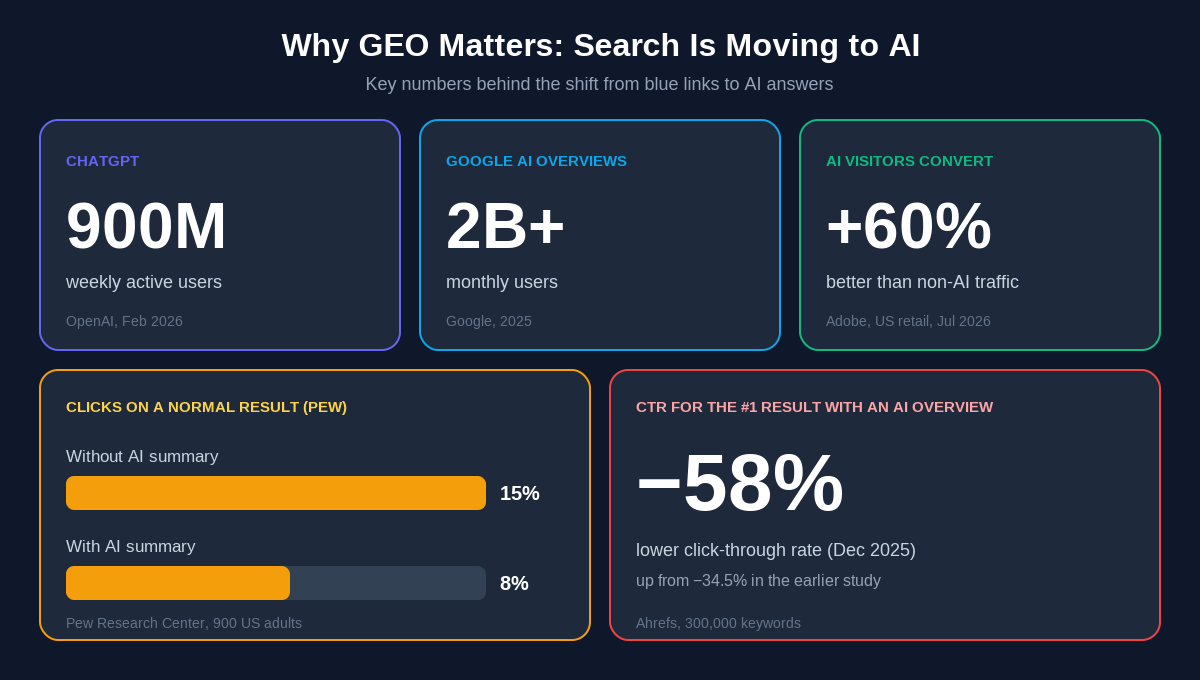
Key numbers behind the shift from blue links to AI answers.
In short: AI answers take some clicks away, but the visitors who do come from AI are often ready to act. Being cited is the new ranking.
GEO vs SEO vs AEO: What's the Difference?
These three terms overlap a lot. Here's how they compare.
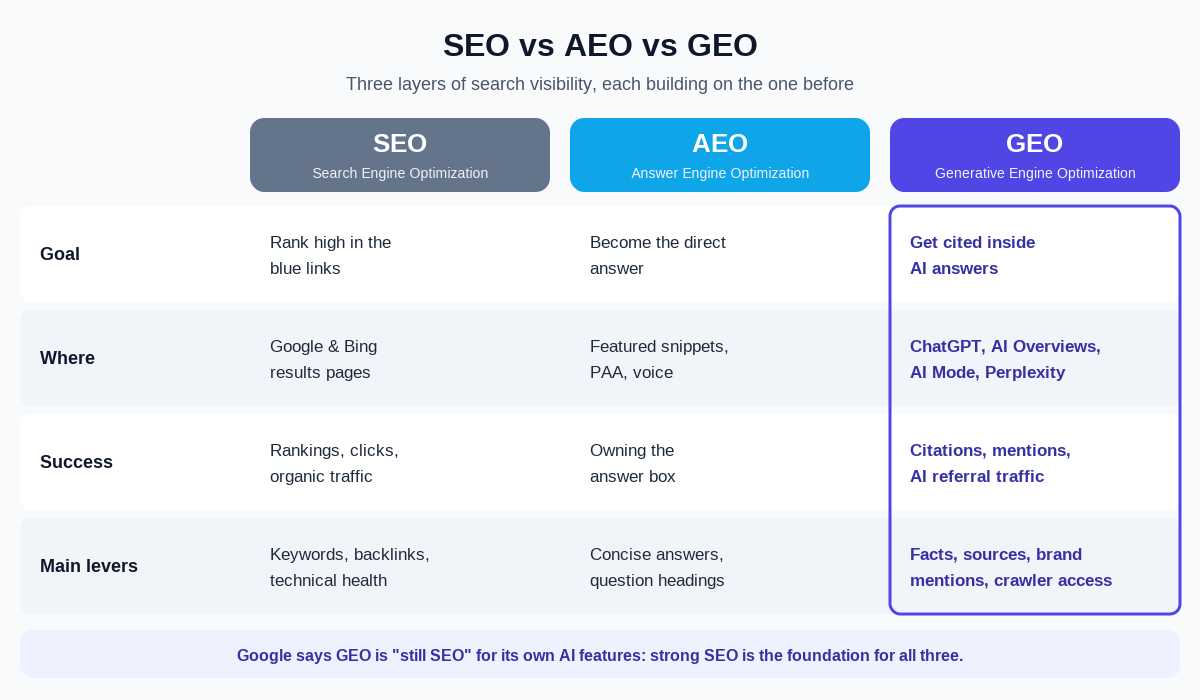
SEO vs AEO vs GEO at a glance.
SEO (search engine optimization)
Goal: rank your page high in the classic list of blue links.
Where: Google and Bing search results.
Success metric: rankings, impressions, clicks and organic traffic.
Main levers: keywords, content quality, backlinks, technical health.
AEO (answer engine optimization)
Goal: become the direct answer to a question.
Where: featured snippets, "People Also Ask", voice assistants.
Success metric: owning the answer box or the spoken answer.
Main levers: concise answers, question-style headings, FAQ formatting.
GEO (generative engine optimization)
Goal: get cited, quoted or recommended inside AI-generated answers.
Where: ChatGPT, Google AI Overviews and AI Mode, Gemini, Perplexity, Copilot.
Success metric: citations, brand mentions, share of AI voice and AI referral traffic.
Main levers: facts and statistics, credible sources, clear structure, brand mentions across the web, and crawler access.
Is GEO just SEO with a new name?
Partly, yes, and it's important to be honest about this. In May 2026, Google published official guidance on optimizing for its generative AI features. It says AEO and GEO are still SEO for Google Search: AI Overviews and AI Mode use the same index and ranking systems, and no special files or markup are needed.
But GEO isn't only about Google. ChatGPT, Perplexity and Copilot have their own crawlers and their own ways of choosing sources, and research shows that brand mentions off your site matter far more for AI visibility than for classic rankings. So the smart approach is: keep strong SEO as your foundation, then add GEO habits on top.
How Generative Engines Choose Which Sources to Cite
When you ask an AI search tool a question, it usually goes through five steps:
Understand the question. The AI figures out what you're really asking and what kind of answer would help.
Fan out into sub-queries. It often breaks your question into several smaller searches behind the scenes. Bing even shows site owners these "grounding queries" in its webmaster tools.
Retrieve candidate pages. It pulls pages from a search index, so if your page isn't crawlable and indexed, it can't be chosen.
Select the best passages. It picks the passages that answer each sub-question most clearly and credibly.
Write the answer and add citations. It synthesizes one answer and links the sources it relied on.
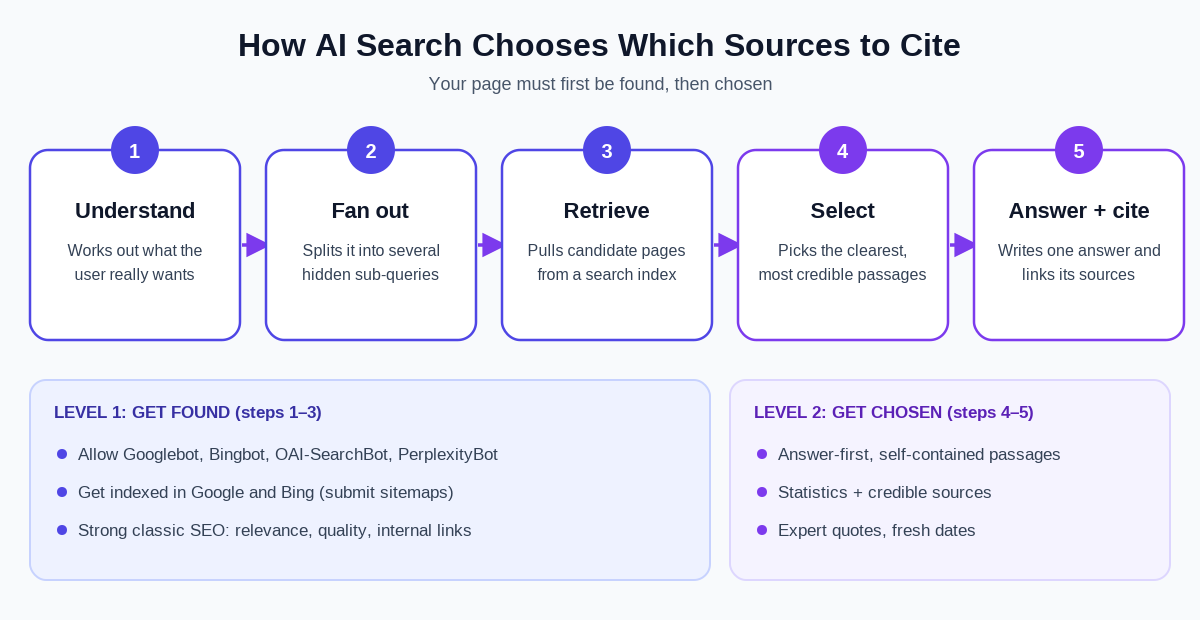
How AI search picks the sources it cites: first get found, then get chosen.
What this means for you: you need to win at two levels. First, your page must be found (classic SEO and crawler access). Second, individual passages must be chosen (clear, factual, self-contained writing).
What the Original GEO Research Found
The Princeton-led GEO study tested nine ways of rewriting web content and measured how often AI engines then showed it. The headline result: the right changes boosted visibility in AI answers by up to 40%.
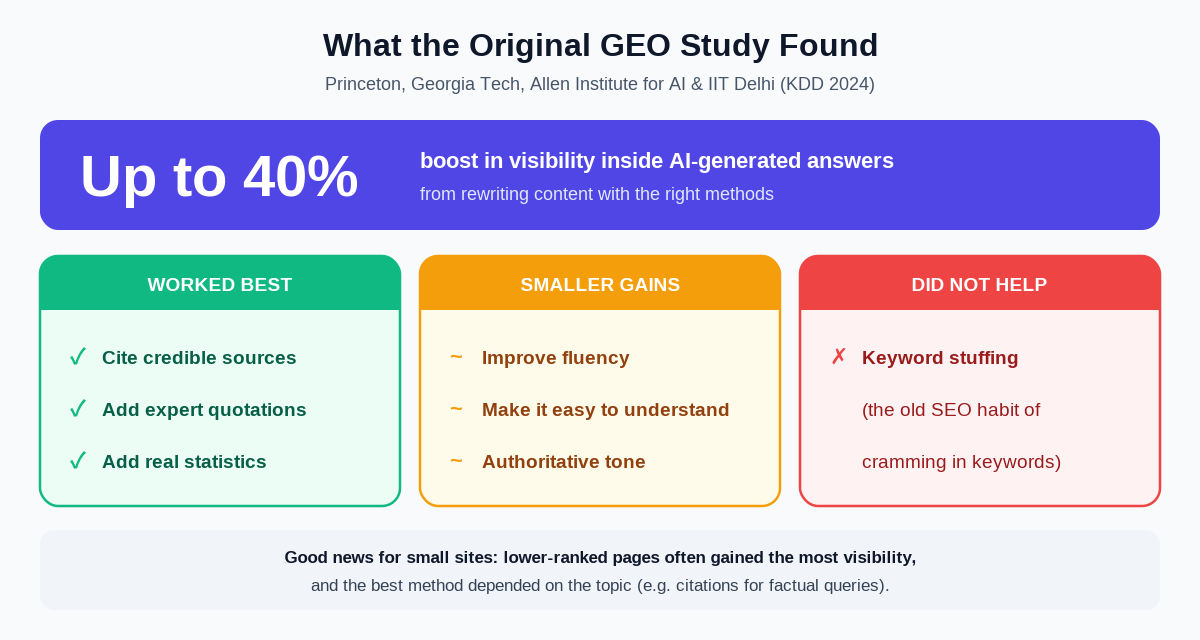
Key findings from the original Princeton-led GEO study.
Cite sources: adding references to credible sources was one of the strongest methods.
Add quotations: quotes from credible experts helped content stand out.
Add statistics: replacing vague claims with real numbers increased visibility.
Improve fluency and readability: clearer writing gave smaller but real gains.
Keyword stuffing: the old SEO habit of cramming in more keywords did not help.
Two more findings are encouraging for small sites. The best method depended on the topic: citations worked well for factual queries, while authoritative tone helped in areas like debates and history. And lower-ranked pages often gained the most, so you don't need to be a giant brand to benefit.
12 Generative Engine Optimization Strategies That Work
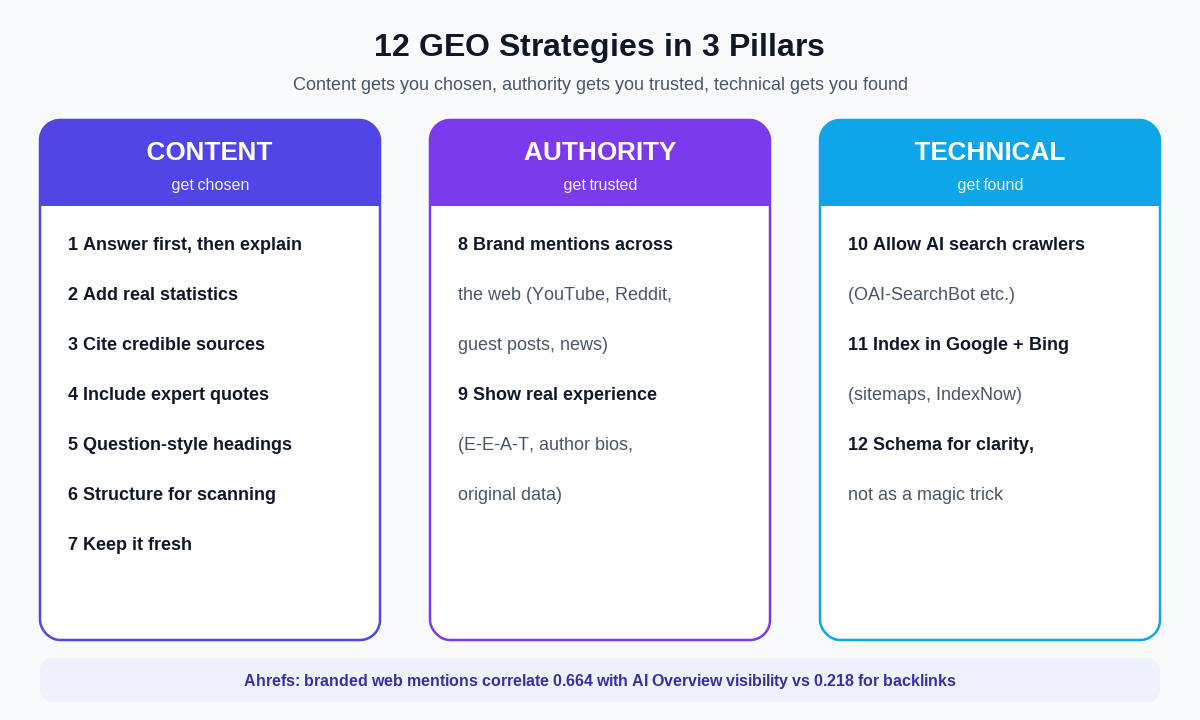
The 12 GEO strategies grouped into three pillars.
Content strategies
Answer first, then explain. Start each section with a direct 1–2 sentence answer, then add detail. AI engines love passages that make sense on their own.
Add real statistics. Swap "many people use AI search" for "ChatGPT reported 900 million weekly users in February 2026." Specific, sourced numbers are easy for AI to quote.
Cite credible sources. Link to original research, official documentation and government data, not to other blogs repeating the same claim.
Include expert quotes. A short, attributed quote from a recognized expert adds authority that AI systems can reuse.
Use question-style headings. Write H2s and H3s the way people ask questions ("How much does GEO cost?") so each section maps to a real query.
Structure for scanning. Use short paragraphs, numbered steps, bullet lists and comparison sections. Clear structure makes it easier to pull out the right passage.
Keep it fresh. Update statistics and dates regularly, and show a visible "last updated" date. Outdated numbers are a reason not to cite you.
Authority strategies
Get mentioned across the web. In an Ahrefs study of 75,000 brands, branded web mentions showed the strongest correlation (0.664) with appearing in AI Overviews, far more than backlinks (0.218). A later Ahrefs study found YouTube mentions correlated even more strongly with AI visibility. Guest posts, podcasts, YouTube videos, Reddit and Quora answers, and news coverage all help.
Show real experience (E-E-A-T). Add author bios with credentials, first-hand examples, original screenshots and your own data. Unique information is hard for AI to find elsewhere.
Technical strategies
Let AI search crawlers in. Check your robots.txt. OpenAI says sites that block
OAI-SearchBotwon't be shown in ChatGPT search answers. You can still blockGPTBot(used for model training) separately without affecting search citations. Also make sure your CDN or firewall isn't blocking bots by accident.Be indexed on Google and Bing. Submit your sitemap to both Google Search Console and Bing Webmaster Tools. Google's AI features only show pages that are indexed and eligible for a snippet.
Use schema markup for clarity, not magic. Article, FAQ, HowTo and Organization schema help search engines understand your page. Google says special schema isn't required for its AI features, so treat it as good hygiene rather than a GEO shortcut.
How to Optimize for Each AI Platform
The core strategy is the same everywhere, but each platform has a few specifics worth knowing.
Google AI Overviews and AI Mode: these draw on Google's regular search index and ranking systems. Strong classic SEO is your best lever. Your page must be indexed and eligible to show a snippet, so avoid
nosnippettags on pages you want cited.ChatGPT search: allow
OAI-SearchBotin robots.txt, keep facts fresh, and build brand mentions on sites people trust, because ChatGPT often recommends brands it sees discussed widely.Microsoft Copilot: Copilot relies on Bing, so verify your site in Bing Webmaster Tools, submit your sitemap, and use IndexNow to tell Bing about new or updated pages instantly.
Perplexity: Perplexity cites sources heavily and inline. Allow
PerplexityBot, and write fact-dense, well-sourced passages that can stand alone as a quoted answer.
GEO Myths to Ignore
"You must add an llms.txt file." Google says you don't need llms.txt or other special AI files for its generative features. An Ahrefs study of 137,000 sites found that 97% of llms.txt files received zero traffic in May 2026.
"Rewrite everything into tiny chunks for AI." Google's guidance says AI-specific rewriting and content chunking aren't needed. Write clearly for humans, and the structure that helps readers helps AI too.
"More keywords = more AI visibility." The GEO study found keyword stuffing didn't help. Facts and sources did.
"GEO replaces SEO." AI search engines still retrieve pages from search indexes. Without solid SEO, GEO has nothing to build on.
Best GEO Tools and Their Prices in India (₹)
Prices below are converted at roughly ₹94 per US dollar (mid-November 2026 rates) and rounded. Most of these tools bill in dollars, so Indian buyers may also pay 18% GST and a card forex markup on top. Always check the vendor's pricing page before buying.
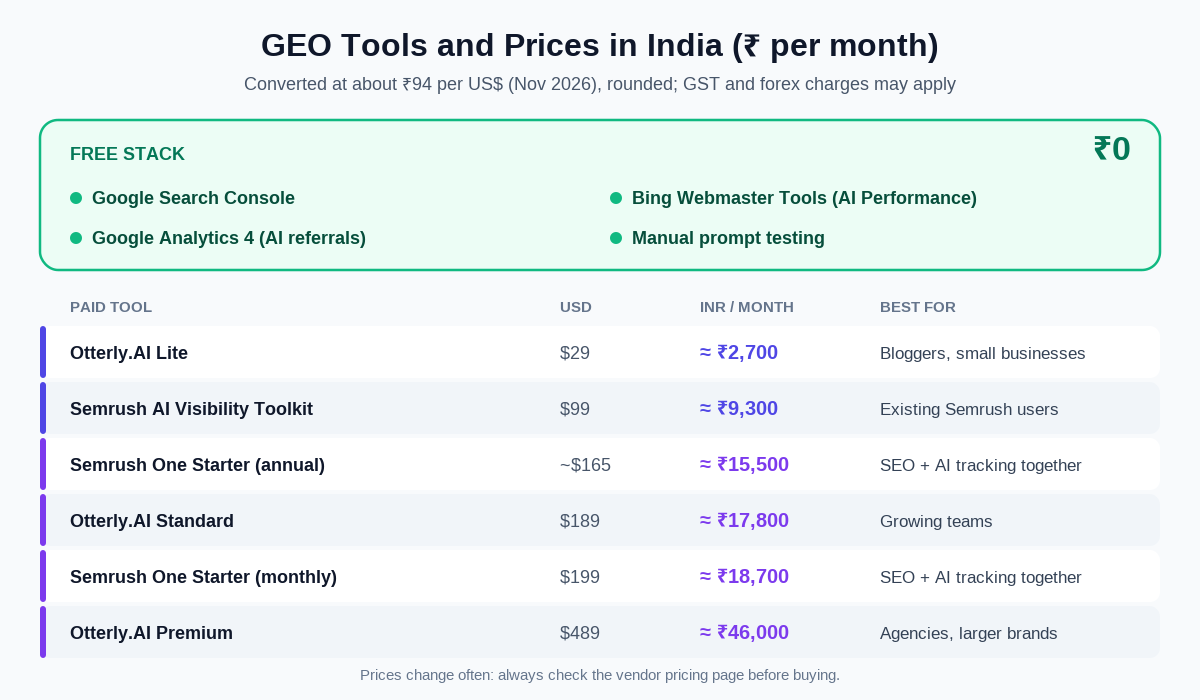
GEO tools and their approximate monthly prices in Indian rupees.
Free tools (₹0)
Google Search Console: traffic from AI Overviews and AI Mode is counted inside the normal Performance report.
Bing Webmaster Tools AI Performance: launched in public preview in February 2026, it shows how often your pages are cited in Microsoft Copilot and Bing's AI summaries, plus the grounding queries behind those citations.
Google Analytics 4: track referral traffic from sources like chatgpt.com, perplexity.ai, gemini.google.com and copilot.microsoft.com.
Manual prompt testing: ask ChatGPT, Gemini and Perplexity the questions your customers ask, and note who gets cited.
Paid tools
Otterly.AI: tracks brand mentions and citations across ChatGPT, Perplexity and Google AI Overviews. Lite costs $29/month (about ₹2,700), Standard $189/month (about ₹17,800), and Premium $489/month (about ₹46,000). A 14-day free trial is available. Best for: bloggers and small businesses starting out.
Semrush AI Visibility Toolkit: $99/month per domain (about ₹9,300), with no free trial. Best for: marketers already using Semrush.
Semrush One (SEO + AI visibility): Starter is $199/month (about ₹18,700), or about $165/month (about ₹15,500) when billed annually. Best for: teams that want classic SEO and AI tracking in one place.
Tip: if you're a new blogger, start with the free stack for 2–3 months. Upgrade only when you have content worth tracking and a budget that makes sense.
How to Measure Your GEO Results
Build a prompt list. Write 20–30 real questions your audience asks, for example "best AI SEO tools for small business in India."
Test monthly. Run them in ChatGPT, Gemini, Perplexity and Google AI Mode. Record whether your brand is mentioned, cited or missing.
Track AI referrals in GA4. Create a custom channel group for AI sources so you can see visits, engagement and conversions.
Check Bing's AI Performance report. Look at which pages get cited and which grounding queries trigger them.
Measure share of voice. Compare how often you're cited versus your top three competitors for the same prompts.
GEO for Indian Bloggers and Businesses
India deserves special attention. Google was the first to expand AI Mode internationally to India in June 2025, and it says Indian users form its largest user base for both voice and visual search globally. That creates some specific opportunities:
Answer spoken-style questions. People speak longer, more natural queries ("which laptop is best for coding under 60,000 rupees"). Use those exact phrasings in your headings.
Use local context. Add rupee prices, Indian examples, city names and India-specific regulations. Generic global content is easy for AI to find elsewhere; local detail makes you the best source.
Add clear images and video. With heavy use of Google Lens, descriptive images, alt text and YouTube videos give you more ways to be surfaced.
Consider Hindi and regional languages. AI Overviews are available in 40+ languages, and competition in regional languages is often lower than in English.
Your 30-Day GEO Action Plan
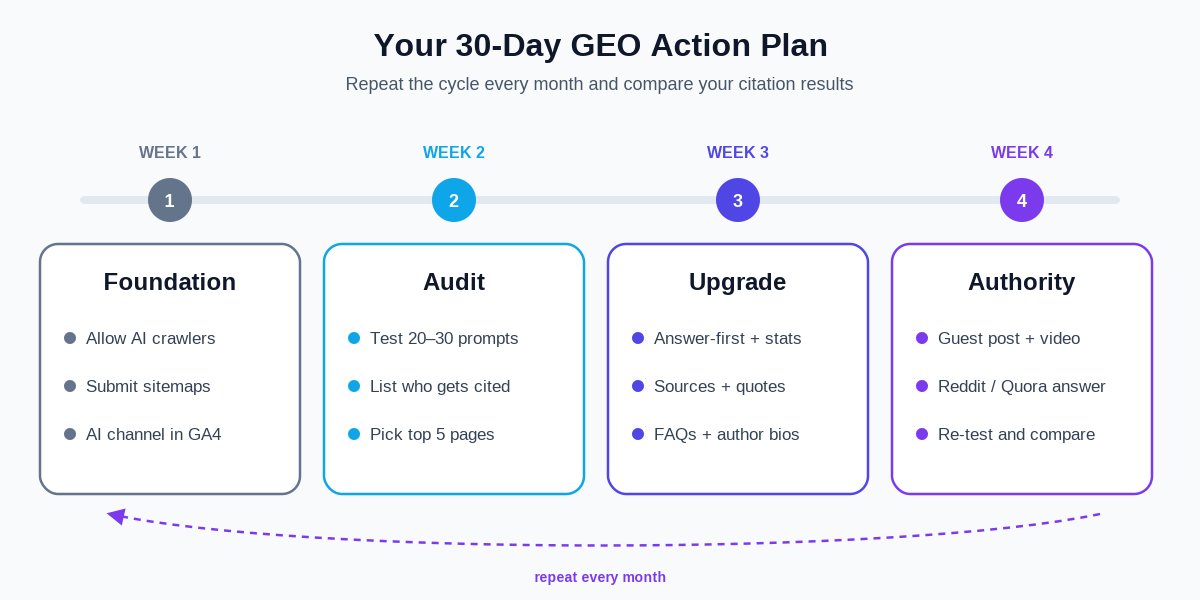
A simple four-week GEO plan you can repeat every month.
Week 1: Foundation
Check robots.txt and allow Googlebot, Bingbot, OAI-SearchBot and PerplexityBot.
Submit your sitemap to Google Search Console and Bing Webmaster Tools.
Set up an AI referral channel in GA4.
Week 2: Audit
Run your 20–30 test prompts in four AI tools and record the results.
List the competitors and sources that are cited instead of you.
Pick your 5 most important pages to upgrade first.
Week 3: Upgrade content
Add answer-first summaries, fresh statistics with sources and at least one expert quote to each page.
Rewrite headings as questions and add an FAQ section.
Add author bios and a visible "last updated" date.
Week 4: Build authority
Publish one guest post, one helpful Reddit or Quora answer and one short YouTube video on your topic.
Re-run your test prompts and compare against Week 2.
Repeat the cycle every month.
The Future of Generative Engine Optimization
The trends below are forecasts and early signals, not guarantees.
AI-first search keeps growing. Back in 2024, Gartner predicted traditional search engine volume would drop 25% by 2026 as people turn to AI chatbots. Whether or not that exact number holds, the direction is clear.
Agents will do the searching. AI agents are starting to research, compare and even buy on people's behalf. If you want to understand this shift, read our guide to agentic AI and autonomous AI agents.
Better measurement tools. Bing already shares AI citation data. Expect more platforms to report how often AI cites your content.
Brand becomes the moat. As AI answers summarize the same facts, trusted brands with original data and real experience will win the citations.
Conclusion: Get Cited, Not Just Ranked
Generative engine optimization isn't a replacement for SEO. It's the next layer on top of it. Make sure AI engines can find your pages, write passages that are clear and factual enough to quote, and build a brand that people mention across the web. Do that consistently, and you'll show up wherever your audience asks their questions, whether that's Google, ChatGPT or the next AI tool.
Over to you: Have you checked whether ChatGPT or Google AI Mode mentions your brand yet? Share what you found in the comments, pass this guide to a fellow marketer or blogger, and subscribe for more practical guides on AI, SEO and GEO.
Frequently Asked Questions
Durgesh Kumar
Founder of TechBlogAI. Writing about Artificial Intelligence, Autonomous Agents, Search Systems, and Full-Stack Architecture.
Never Miss an Architectural Breakdown
Subscribe to receive weekly deep-dives on Generative Engine Optimization, algorithmic search, and scalable web engineering.