
Boring Tech Wins at 2 AM: Designing Systems You Can Actually Debug Under Pressure
When production breaks at 2 AM, boring technology wins. Learn why battle-tested tools like PostgreSQL, Redis and plain REST APIs are easier to debug under pressure, with simple commands, a 2 AM incident playbook and a starter stack for small teams.


boring-tech-wins-at-2am-debug-under-pressure
Key Architecture Takeaways
- Boring technology is well understood: we know what it can do and, just as importantly, how it fails.
- Spend your few innovation tokens only where new tech helps your product stand out; keep the database, cache and API style boring.
- PostgreSQL, Redis and REST come with simple built-in tools like pg_stat_activity, EXPLAIN ANALYZE, SLOWLOG and curl.
- Design for debugging: request IDs, structured logs, the four golden signals, timeouts, feature flags and easy rollbacks.
- During an incident, stop the customer impact first, then find the root cause, then write a blameless postmortem.
It is 2:07 AM. Your phone is buzzing again and again. It is the Diwali sale, and customers are saying the checkout page is stuck. Payments are going through on the UPI side, but orders are not getting created. Your manager is awake. The WhatsApp group is getting louder.
You open your laptop with sleepy eyes. Now one question decides how this night will go: can you understand your own system when you are tired, stressed and in a hurry?
This is where boring technology wins. Tools like PostgreSQL, Redis and simple REST APIs are not exciting to talk about at tech conferences. But at 2 AM, they are the tools that help you find the problem, fix it and go back to sleep. In this post, you will learn why, with practical tips you can use in your own projects.
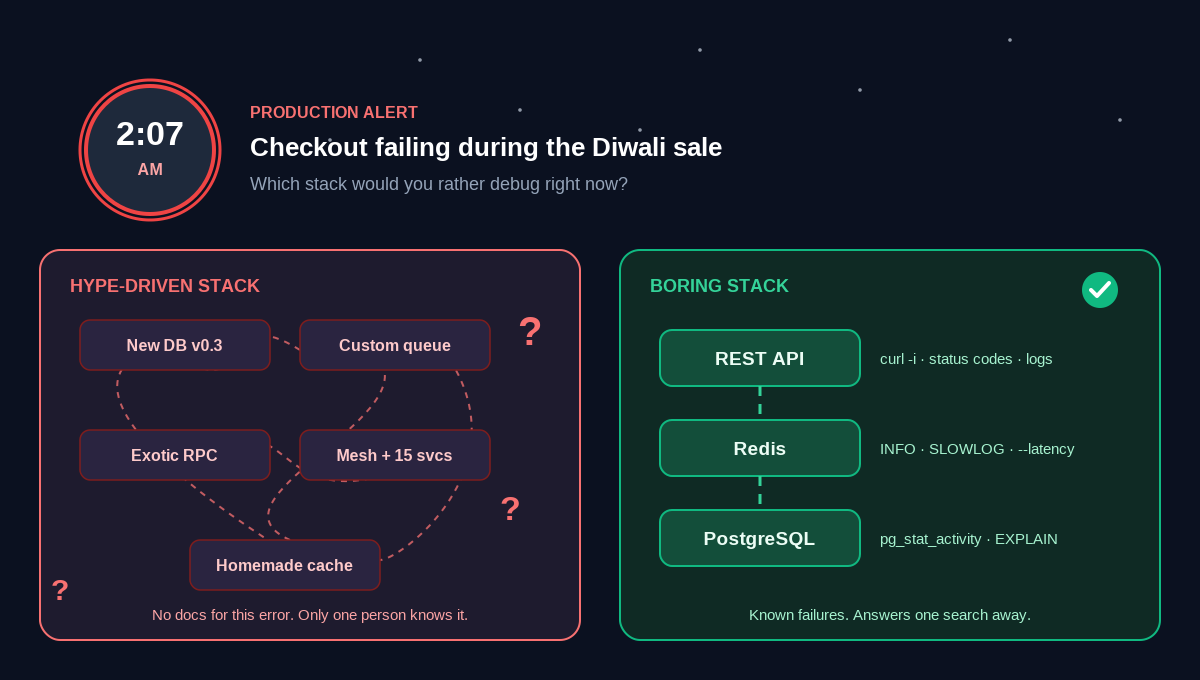
At 2 AM, a stack you understand beats a stack that looks exciting.
What Does "Choose Boring Technology" Mean?
The idea comes from a famous 2015 essay by software engineer Dan McKinley called "Choose Boring Technology". In it, he lists tools like MySQL, Postgres, PHP, Python, Memcached and cron as boring. Here, "boring" is a compliment.
In his talk on the same topic, McKinley explains that boring technology is well understood. We know what it can do, and just as importantly, we know how it fails.
A simple way to think about it: boring tech is like a Maruti or a Honda Activa. It is not the most exciting vehicle on the road. But if it breaks down in a small town at night, any mechanic can fix it, and spare parts are available in every market. A rare imported sports car may be faster, but good luck finding a mechanic at 2 AM.
The "innovation tokens" idea
McKinley also gave a useful rule. Imagine every team gets only about three innovation tokens. Each time you choose a new, unproven tool, you spend one token. Boring tools are free.
So spend your tokens only where new technology really helps your product stand out. For everything else, like your database, your cache and your API style, pick the boring option.
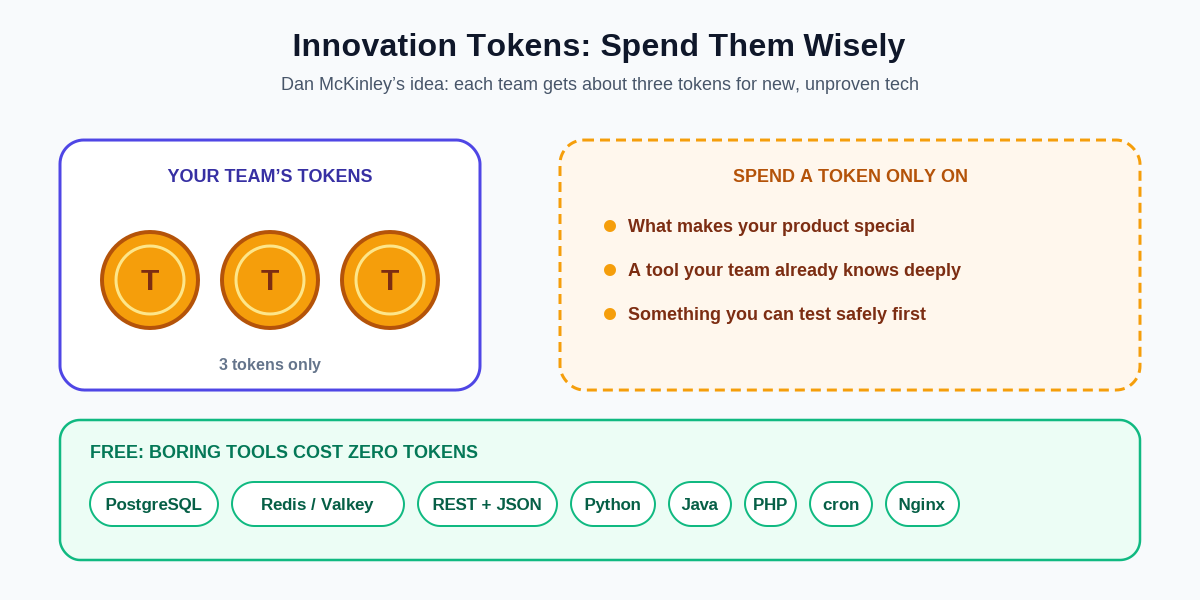
McKinley’s innovation tokens: boring tools are free, new tools cost a token.
Why Boring Tech Wins When Production Breaks
When everything is working, almost any tech stack looks good. The real test comes during an incident. Here is why boring tools pass that test.
The failure modes are known. Thousands of teams have already hit the same bugs. Slow queries, full disks, memory limits and lock waits are documented problems with documented fixes.
Answers are one search away. When you paste an error message from PostgreSQL or Redis into Google, you usually find a clear answer from someone who solved it years ago. With a brand-new tool, you may find nothing.
The debugging tools are mature. Boring tools come with built-in ways to look inside them. You do not need to build your own monitoring from zero.
More people can help. More engineers know these tools, so your on-call teammate, a new hire or a friend in another company can help you quickly.
Fewer moving parts. Simple systems have fewer places to hide problems. Google's Site Reliability Engineering book has a section called "The Virtue of Boring" and says that, unlike almost everything else in life, "boring" is a good thing in software.
There is also a real speed advantage. In Google's DORA research on software delivery, the best-performing teams recover from failed deployments in less than one hour. That kind of speed is much easier when your team deeply understands every tool in the stack.
The 2 AM Test: Hype Stack vs Boring Stack
Before adding any tool to your stack, ask yourself these five questions. Imagine it is 2 AM and the tool is broken.
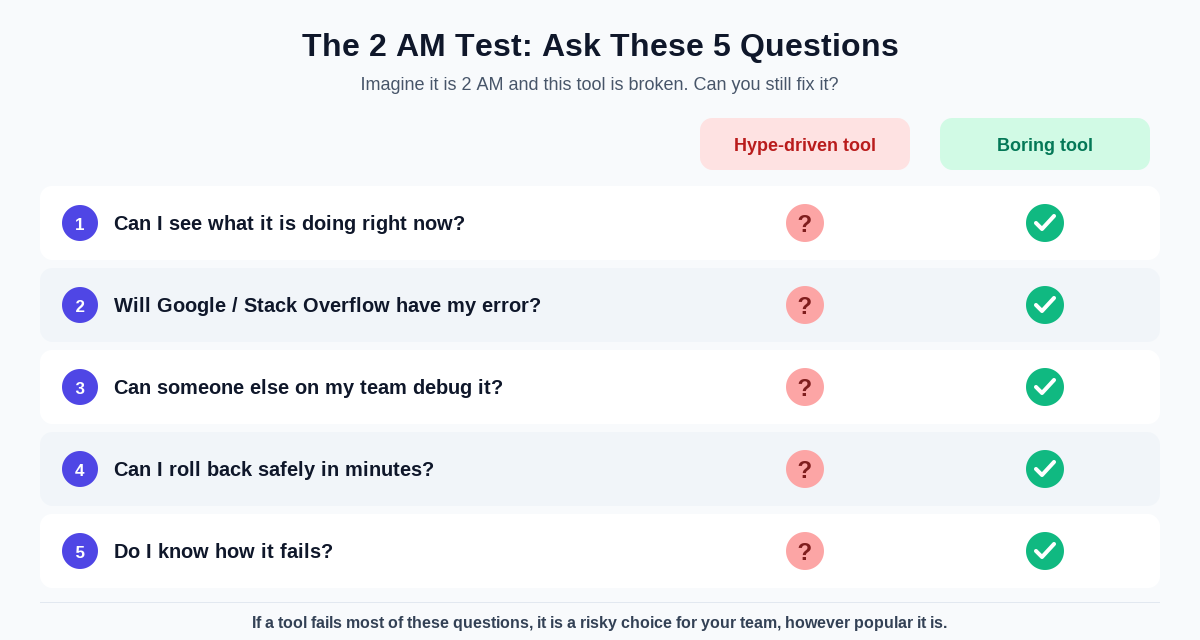
Five quick questions to test any tool before it enters your stack.
Can I see what it is doing right now? Are there simple commands or dashboards that show current activity?
Will Google or Stack Overflow have my exact error? Is there a big community that has already faced this problem?
Can someone else on my team debug it? Or does only one person understand it?
Can I roll back safely? Is there a simple, tested way to undo a bad change?
Do I know how it fails? Does it fail in clear, predictable ways, or in strange, silent ways?
If a tool fails most of these questions, it is a hype-driven choice for your team, even if it is popular on social media. A tool that passes all five is "boring" in the best sense.
PostgreSQL: The Boring Database That Does Almost Everything
PostgreSQL is one of the best examples of boring technology. It grew out of a Berkeley research project from the 1980s. Its community celebrates July 8, 1996 as its birthday, when the first public code repository was set up, so it turned 30 years old in 2026. And it is more popular than ever. In the 2025 Stack Overflow Developer Survey, PostgreSQL was the most used, most desired and most admired database among developers.
Why it is great at 2 AM
PostgreSQL gives you clear windows into what is happening inside it. Here are the most useful ones during an incident:
pg_stat_activityshows every running query, how long it has been running and whether it is waiting.EXPLAIN ANALYZEshows exactly how a query runs and where time is spent, so you can spot a missing index.pg_stat_statements(an extension) shows which queries use the most time overall.pg_lockshelps you find which query is blocking others.
For example, this one query often finds the problem in under a minute:
SELECT pid, state, wait_event_type, now() - query_start AS running_for, left(query, 80) AS query
FROM pg_stat_activity
WHERE state <> 'idle'
ORDER BY running_for DESC;
One database, many jobs
Another big benefit: PostgreSQL can do many jobs that teams often add separate tools for. It can store JSON documents (JSONB), handle full-text search, and even work as a simple job queue using SELECT ... FOR UPDATE SKIP LOCKED. Every extra system you avoid is one less thing that can break at 2 AM.
Redis: The Boring Cache, Used the Right Way
Redis is a fast in-memory data store, mostly used as a cache, for sessions and for rate limiting. It is simple, well documented and widely used. In the 2025 Stack Overflow survey, Redis was one of the top five most used databases and one of the fastest growing.
Useful Redis commands during an incident
INFO memoryandINFO statsshow memory use, evicted keys and hit or miss rates.SLOWLOG GET 10shows the slowest recent commands.redis-cli --latencyquickly measures how slow Redis feels from your server.MONITORshows every command live, but use it only for a few seconds because it slows Redis down on busy servers.
Simple rules that prevent most Redis incidents
Always set a TTL (expiry time) on cache keys, so old data does not fill memory forever.
Set
maxmemoryand an eviction policy, so Redis removes old keys instead of crashing when memory is full.Treat the cache as optional. Your app should still work, just slower, if Redis goes down. Never keep the only copy of important data in a cache.
A lesson: even boring tools can change
In March 2024, Redis changed its license from the open source BSD license to a more restrictive one. Within days, the Linux Foundation backed Valkey, an open source fork that continued from Redis 7.2.4. Then in 2025, Redis 8 added the open source AGPLv3 license as an option.
The lesson is simple: boring does not mean "never changes." Use standard commands and avoid locking yourself into one vendor's special features. Then, if you ever need to switch, it is a small project and not a crisis.
Standard REST: The API You Can Debug With curl
A simple REST API over HTTP and JSON is boring in the best way. You can test any endpoint from your terminal with one command:
curl -i -H "X-Request-ID: debug-2am-001" https://api.example.com/orders/12345In seconds you see the status code, the headers and the response body. No special client, no code generation, no extra tools.
Status codes tell a story. 4xx means "the request was wrong." 5xx means "the server failed." 429 means "too many requests." 503 or 504 often means "something behind me is slow or down."
Every tool understands HTTP. Load balancers, browsers, logging tools, API gateways and CDNs all speak HTTP, so the whole path is easy to trace.
Logs are readable. One line per request, with method, path, status and time taken, is easy to search when you are tired.
GraphQL and gRPC are good tools with real benefits, especially for complex frontends or high-performance internal services. But they need extra tooling and knowledge to debug. If your team does not already know them well, plain REST is the safer default.
How to Design Systems You Can Debug Under Pressure
Choosing boring tools is step one. Step two is designing your system so that problems are easy to see. Here is a practical checklist.
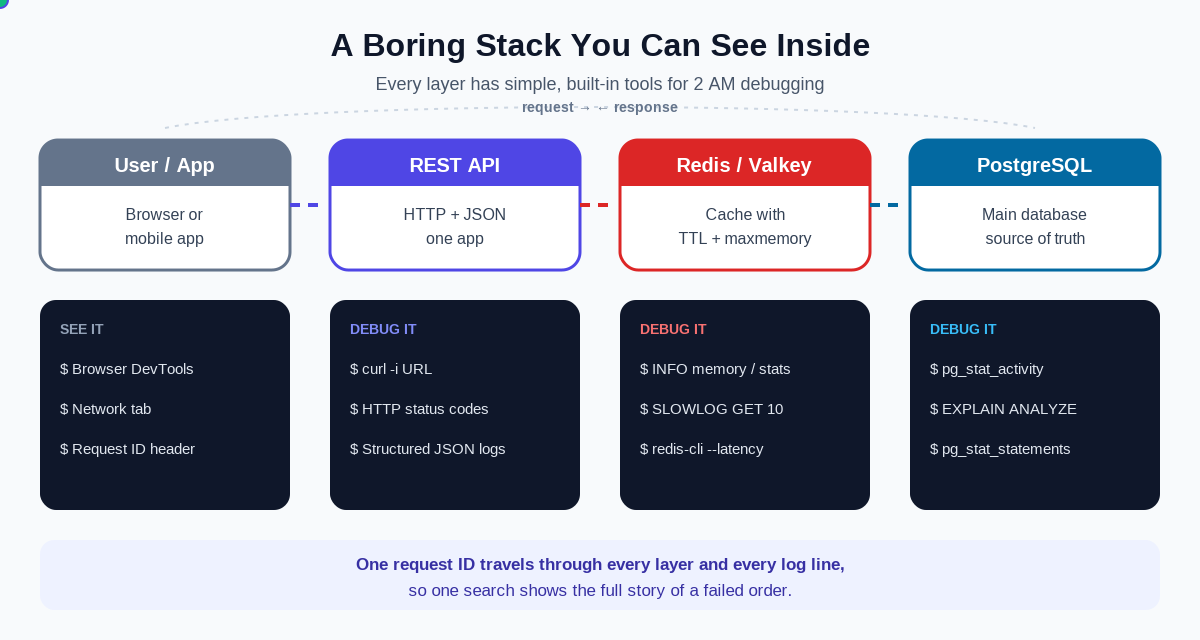
Every layer of a boring stack has simple tools to look inside it.
Add a request ID to everything. Generate a unique ID for each request at the edge and pass it through every service and log line. Then one search shows the full story of a failed order.
Use structured logs. Log in JSON with fields like
request_id,user_id,statusandduration_ms. Avoid logging sensitive data like passwords, card numbers or Aadhaar numbers.Watch the four golden signals. The Google SRE book recommends tracking latency, traffic, errors and saturation. One simple dashboard with these four is worth more than 50 fancy charts.
Set timeouts everywhere. Every database call, cache call and outside API call needs a timeout. Without timeouts, one slow service can freeze everything.
Make rollback one click. Keep deployments small, and make sure you can go back to the last good version quickly. Practise it when things are calm.
Use feature flags for risky changes. Turning off a feature is faster and safer than an emergency code change.
Prefer a monolith until you truly need more. A well-structured single app with one database is far easier to debug than 15 small services talking over the network.
Write runbooks. A runbook is a short, step-by-step guide for common problems, like "database CPU is 100%" or "Redis memory is full."
Runbooks matter more than most people think. The Uptime Institute's 2025 outage analysis found that among outages linked to human error, 85% came from staff not following procedures or from flaws in the procedures themselves. Clear, simple and tested runbooks help people do the right thing even when they are half asleep.
A Simple 2 AM Incident Playbook
When the alert comes, follow these steps in order. Do not skip to "find the root cause" first.
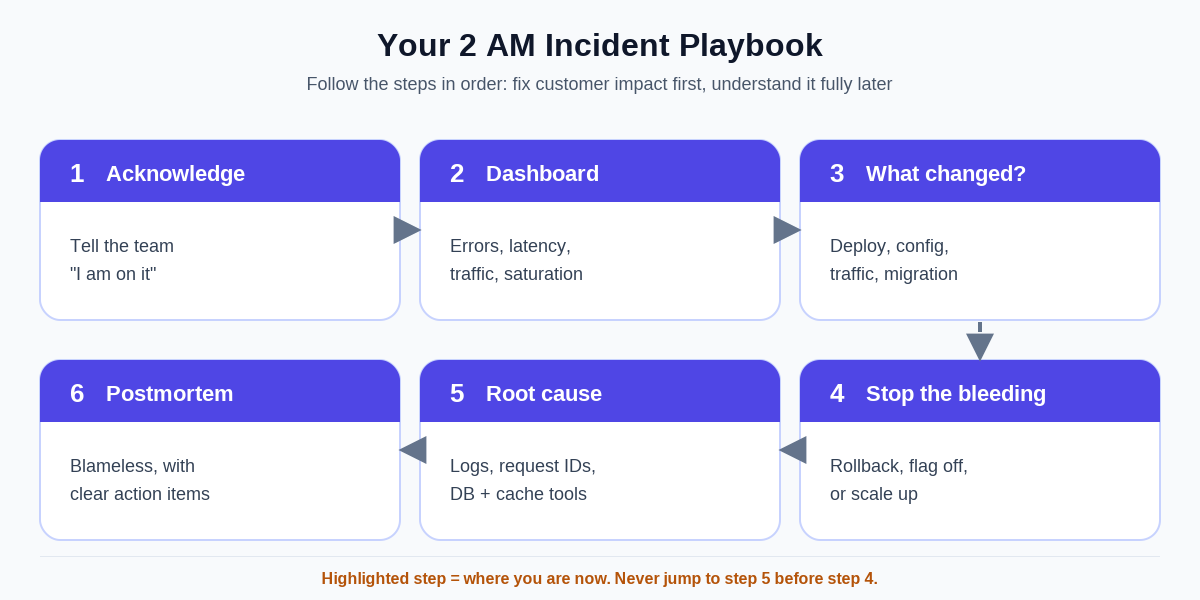
The six-step incident playbook, in order.
Acknowledge and tell people. Reply in the incident channel: "I am on it, checking now." This stops five people from doing the same thing.
Check the dashboard. Look at errors, latency, traffic and saturation. Which one changed, and when?
Ask "what changed?" Most incidents follow a change: a deployment, a config update, a traffic spike or a database migration.
Stop the bleeding first. Roll back, turn off a feature flag, or scale up. Fixing the customer impact comes before understanding it fully.
Find the root cause. Once things are stable, use your logs,
pg_stat_activity, RedisSLOWLOGand request IDs to understand what really happened.Write a blameless postmortem. Write down what happened, why, and what you will change. Focus on fixing systems and processes, not blaming people.
Example: Solving the Diwali Checkout Incident
This is an example scenario to show how the pieces fit together.
Let us go back to the story at the start. Orders are not getting created, but payments are going through. Here is how a boring stack helps you solve it in minutes.
2:09 AM: Dashboard check. The error rate on
POST /ordersjumped from 0.1% to 30% at 1:52 AM. Latency is also very high. Traffic is high, but not unusual for a sale.2:11 AM: What changed? The deploy log shows a release at 1:45 AM that added a new "festive offer" check to the order flow.
2:13 AM: Look inside the database. You run the
pg_stat_activityquery. Many queries are waiting on the sameSELECTon theofferstable, each running for 20+ seconds.2:15 AM: Confirm with EXPLAIN.
EXPLAIN ANALYZEshows a full table scan on a large table. The new query is missing an index.2:16 AM: Stop the bleeding. You turn off the "festive offer" feature flag. Within a minute, the error rate drops back to normal and orders start flowing again.
2:30 AM: Fix it properly. You add the missing index using
CREATE INDEX CONCURRENTLY, so the table is not locked, and plan to turn the flag back on after testing.Next morning: Postmortem. The team adds a rule to review query plans for new database queries before big sale days, and handles the payments that came in while orders were failing.
Notice that nothing here needed special tools or rare expertise. A dashboard, a deploy log, two standard PostgreSQL commands and a feature flag were enough. That is the real power of boring technology.
When Is New Technology Worth It?
Boring tech is not about refusing everything new. Remember the innovation tokens: you still have a few to spend. New technology can be the right choice when:
It solves your core business problem in a way boring tools truly cannot.
Your team already knows it well. A tool your team knows deeply is "boring" for you, even if it is new to the industry.
You can test it safely on a small, non-critical part of the system first.
It has a healthy community, good documentation, and more than one company using it in production.
You have a clear exit plan if it does not work out.
The mistake is not using new tools. The mistake is using many new tools at the same time, everywhere, just because they are trending.
A Boring Starter Stack for Indian Startups and Small Teams
If you are building a new product in 2026, here is a simple stack that will take you very far without many 2 AM surprises:
One well-structured backend app in a language your team knows well, such as Python, Java, Node.js, Go or PHP.
PostgreSQL as your main database, ideally a managed service with automatic backups.
Redis or Valkey as a cache, with TTLs and memory limits set from day one.
Plain REST APIs with JSON and proper HTTP status codes.
A simple job queue, even PostgreSQL-based, for background work like sending emails or SMS.
Basic monitoring for the four golden signals, plus structured logs with request IDs.
Automated deployments with an easy rollback button.
This stack is not flashy. But it is well understood, widely supported, and easy to hire for, and it lets your team spend its energy on what makes your product special.
Conclusion: Choose Tools That Let You Sleep
Hype-driven stacks look great in a demo. Boring stacks look great at 2 AM, when the payment page is failing and every minute costs money and trust. PostgreSQL, Redis and standard REST win because thousands of engineers have already found their bugs, written about their failures and built tools to look inside them.
So the next time you choose a tool, ask one simple question: "Will I be able to debug this at 2 AM?" If the answer is yes, you have probably made a good choice.
Over to you: What was your worst 2 AM production incident, and which tool saved you (or hurt you)? Share your story in the comments, send this post to your on-call teammates, and subscribe for more practical guides on web development, AI and building reliable systems.
Frequently Asked Questions
Durgesh Kumar
Founder of TechBlogAI. Writing about Artificial Intelligence, Autonomous Agents, Search Systems, and Full-Stack Architecture.
Never Miss an Architectural Breakdown
Subscribe to receive weekly deep-dives on Generative Engine Optimization, algorithmic search, and scalable web engineering.